
Criminal Cases in the Reeves County Courts
Reeves County criminal cases are divided by charge level and court jurisdiction. The 143rd District Court hears felony matters, and the District Clerk keeps those case files at the Reeves County Courthouse. The Reeves County Court at Law has Class A and Class B misdemeanor jurisdiction, with the County Clerk serving as record custodian. Pecos Municipal Court keeps its own fine-only state-offense, ordinance, and juvenile police-citation matters. Four justice courts also maintain their own low-level dockets and bench or capias records.
This split matters more than the name on a charge. A negative District Clerk search does not rule out a County Court at Law, Pecos Municipal Court, or justice-court case. Start with the alleged offense level and the agency that issued the citation or made the arrest. Then ask the right clerk to confirm the case number, court, filing date, and status. The county clerk-linked portal is a useful first pass, but each Reeves County court remains the source for its own filed record.
Reeves Felony Case Files
The District Clerk is the felony-file custodian for the 143rd District Court. Its public counter is on the second floor of the Reeves County Courthouse at 100 E. 4th Street in Pecos. The office is open Monday through Friday from 8:00 a.m. to 5:00 p.m. Call 432-287-0222, option 6, or write to DistrictClerk@reevescounty.org before a long trip. Clerk services become unavailable during docket, so a call can prevent an unproductive visit.
A Reeves County civil or criminal name search costs $5. Written or emailed copies are $1 per page, and certification adds $5 for each certification. Many requests can be discussed or completed by phone. Official court pleadings cannot be filed by fax or email, though eFileTexas and, in some cases, U.S. mail are accepted. That filing rule does not bar a person from asking the clerk how to obtain an existing public case record.
How to Search Case Records
Use the official online gateway for a broad first search, then confirm the result with the court that owns the file. Reeves County describes the clerk-linked LGS service as a search of court records, but it does not publish criminal coverage years, refresh timing, document prices, or a complete guide to the signed-in interface. A missing result therefore calls for a clerk check, not a guess that no case exists.
- Open the LGS Online Records Search linked by the Reeves County Clerk and choose Guest Login or sign in.
- Use the visible account gateway, then follow the portal prompts to locate the relevant Reeves County court record.
- Compare the court, case number, filing date, party display, and charge to information already known.
- Read docket events and the stated disposition without assuming that a booking charge became the filed charge.
- Contact the District Clerk for a felony or the County Clerk for a Class A or B misdemeanor to request copies or certification.
Municipal and JP matters need a separate check. Pecos Municipal Court is at 115 W. 3rd Street and can be reached at 432-445-2417. The Reeves County justice-court directory lists each precinct office. A court payment link is not the same as a searchable case index.
Reeves LGS Court Records Gateway
The public LGS gateway shown by the assigned source has a limited set of fields before entry. It offers Guest Login as well as account tools. The authenticated results screen was not tested against a private person, so field labels beyond the public gateway should be verified inside a neutral search before relying on them.
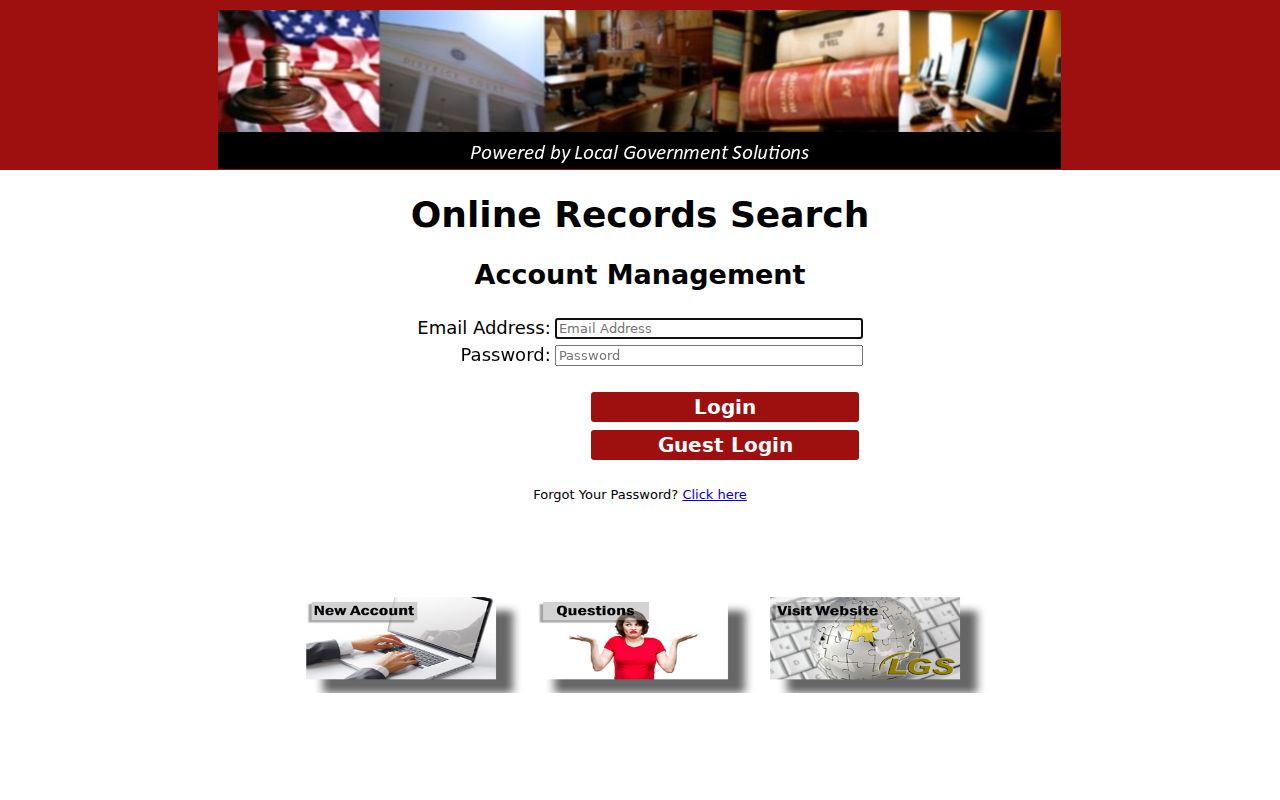
The image shows the access point, not proof of a person or case. The visible controls help a reader choose guest access without overstating which Reeves County criminal files will appear after login.
| Visible control | Type | Required | Use or limit |
|---|---|---|---|
| Email Address | Text | For account login | Used with a registered account |
| Password | Password | For account login | Pairs with the email field |
| Guest Login | Button | No account shown | Starts public guest access |
| Forgot Your Password | Link | No | Account recovery only |
| New Account | Link | No | Creates portal credentials |
| Questions | Link | No | Portal help, not clerk confirmation |
What the Case File Shows
A Reeves County criminal case file follows the prosecution after a complaint, information, or indictment is filed. It can show the charge selected by the prosecutor, court events, pleas, motions, outcome, sentence, and costs. This is broader than the current-custody list and more precise than an arrest report when the question is what the court did. Online views may be less complete than the clerk-held record, especially when an image has not been posted.
| Case Number & Court | Identifies the file and the Reeves County court that controls it. |
|---|---|
| Charging Document | Shows the complaint, misdemeanor information, or felony indictment that put a charge before the court. |
| Docket Entries | List filed papers, settings, hearings, motions, and orders in sequence. |
| Hearing Dates | Record scheduled or completed court events, subject to later changes. |
| Disposition & Judgment | State whether a charge was dismissed, deferred, tried, or resolved by a judgment. |
| Sentence & Conditions | Describe punishment, costs, and court-ordered terms when a conviction or supervision order exists. |
Expected portal fields such as a party display, document images, or financial balances were not confirmed through a private sample. Ask the clerk for the complete public file and a certified copy when the exact wording of a disposition or judgment matters.
Reeves Misdemeanor Case Records
Class A and Class B misdemeanor records are held through the Reeves County Clerk and County Court at Law, not at the District Clerk felony desk. The clerk is in Suite 101 at 100 E. 4th Street, is open from 8:00 a.m. to 5:00 p.m. through lunch, and can be reached at 432-287-0222, option 3. The county identifies extension 452 as the dedicated misdemeanor-record contact.
The published County Clerk schedule lists a $10 criminal search, $1 copies, and $5 certification. Those rates differ from the District Clerk's $5 name search because the offices hold distinct Reeves County criminal records. The County Court at Law is at 103 E. 4th Street and uses option 2. County Clerk requests can also be discussed at countyclerk@reevescounty.org or by fax at 432-400-0822. Give the clerk a full name, an approximate filing period, and any known case number. Ask for a current quote when a request spans many pages or needs more than one certified item.
Note: A felony search fee and a misdemeanor search fee pay separate custodians and do not produce one combined countywide result.
Stages of a Criminal Case
A Texas criminal case may start with an arrest or summons, followed by magistration and prosecutor review. A felony commonly reaches the 143rd District Court through a grand-jury indictment. A misdemeanor may proceed through an information. At arraignment, the charging instrument is presented and a plea is entered. Discovery, motions, and negotiations come before a plea or trial. The judgment and sentence close the trial-court phase unless later motions or an appeal follow.
Case flow: Charges Filed › Arraignment › Pretrial › Plea or Trial › Disposition › Sentencing
Booking language can change during this path. The arresting agency records the initial basis for custody, but the prosecutor decides what to file. A grand jury may return a true bill or no-bill on a proposed felony indictment. Read the charging instrument and final disposition in the Reeves County court file instead of treating an intake label as the lasting charge.
Reeves Criminal Docket Day Access
The District Clerk warns that services are unavailable during docket. That is a local access limit, not a statement that Reeves County criminal court records are closed. Call option 6 before traveling, especially when requesting an archived file, a large copy set, or a certified judgment. The courthouse serves a wide Trans-Pecos area, and the 143rd Judicial District spans Reeves, Loving, and Ward Counties.
If LGS has no document image, note the case number and docket entry that names the item. Ask whether the paper or electronic clerk file holds it, whether it is public, what the page and certification charges will be, and whether the request can be completed by phone or mail. Do not email or fax an official pleading to the clerk. A records request for an existing document and a court filing are different acts.
Access & Restrictions
Adjudicative case files are court records. They do not always follow the same process as an incident report requested from law enforcement under the Texas Public Information Act. Ask the clerk for an indictment, docket, order, judgment, or other case paper. Use a public-information request with the Sheriff or police department for an agency report. Texas Rule of Judicial Administration 12 concerns judiciary administrative records and should not be treated as the rule for every filed criminal document. re:SearchTX is a Texas e-filing access platform, but the official research did not establish it as a complete, free Reeves County criminal-name search.
Access may be restricted by an expunction, order of nondisclosure, juvenile law, victim protections, or a sealing order. Online display can also omit material that is available at the counter. A missing search result does not prove the absence of a Reeves County case. Contact the custodian and ask whether the file is archived, newly filed, in another court, or legally restricted. The broader Reeves County criminal history overview helps separate court, jail, and DPS record systems.
Reading Reeves Criminal Case Outcomes
A disposition is the recorded result or current terminal status of a charge. It must be read by charge, not just by case number. A dismissal ends the filed charge without a conviction on that charge. Deferred adjudication places a person under supervision while final adjudication of guilt is deferred. A conviction is a judgment that reflects guilt. An acquittal is a judgment or verdict of not guilty.
- Pending
- The Reeves County criminal case has not reached a final outcome. Pending does not mean guilty.
- Dismissal
- The filed charge ended without a conviction on that charge.
- Deferred adjudication
- Supervision was ordered while final adjudication of guilt was deferred, subject to the court's order.
- Conviction
- The case has a judgment that reflects guilt and may include a sentence.
- No-bill
- A grand jury did not approve the proposed indictment.
When DPS shows a case as pending but the Reeves County clerk holds a certified dismissal, correction is different from record clearing. Compare the exact identifiers and send the certified outcome through the DPS inaccurate-data process. An accurate but unwanted entry may require separate legal analysis under Texas expunction or nondisclosure law.